
 +971 457 13703
RERA and DLD Compliance Made Easy with Property CRM Software
RERA and DLD Compliance requirements for UAE real estate businesses keep growing, and spreadsheets just weren’t built to keep up. One file track Form A submissions, another has tenant leases, a third is somewhere buried in someone’s inbox. That’s how things slip through the cracks. Property CRM software exists to fix exactly this, pulling property records, client information, and compliance documents into a single place instead of five disconnected ones. Whether it’s RERA, DLD, Trakheesi, Ejari, Mollak, or Oqood, a UAE-focused system can organize the reminders, documents, and financial records tied to each one, so nothing gets lost between departments.
What is RERA & DLD compliance?
The Real Estate Regulatory Agency (RERA) is responsible for the regulation of Dubai’s real estate market. It controls the laws regulating property transactions, required documents, and permits that keep everything legal and above board.
The Dubai Land Department (DLD), on the other hand, is responsible for property registration and other issues related to property transactions.
This raises the question of why any of this is relevant at all. Accurate documentation. Better record keeping. Audits that don’t turn into a scavenger hunt. Fewer manual errors slipping through. And genuinely more transparent property transactions for everyone involved, buyers, agents, and regulators alike.
How does property CRM software simplify RERA compliance?
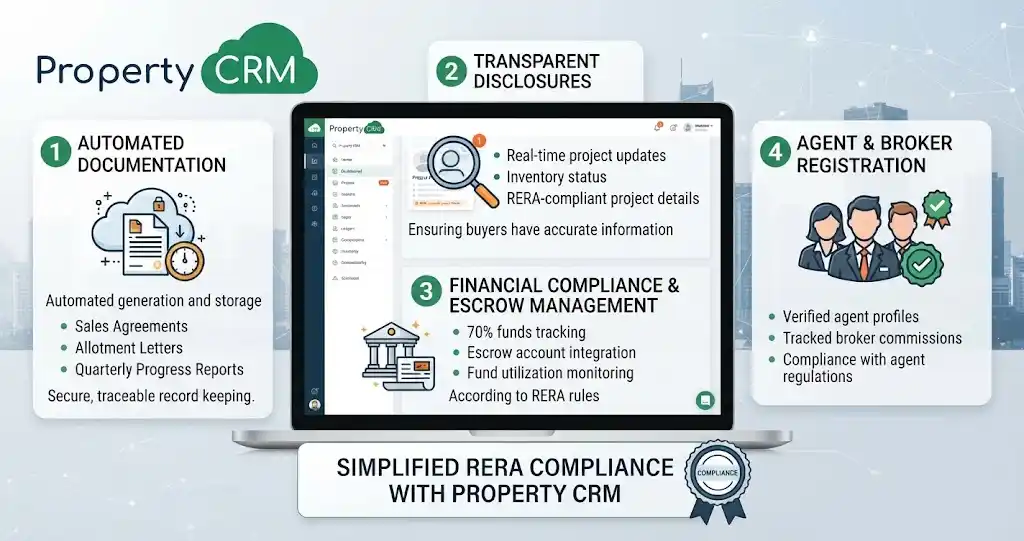
Centralized compliance records
Property and client information sit together instead of scattered across separate files. Documents get stored digitally, and you can actually track their status and any updates without digging through email threads.
RERA forms management
Form A, Form B, and Form F get tracked alongside the documents and transaction progress they’re tied to, rather than living in separate folders that never quite sync up.
How property CRM helps with Ejari & tenant management
Centralized tenant and property information means occupant records, lease details, renewal tracking, and rent or cheque tracking all live in one system. Automated reminders handle upcoming payments or actions before they become a scramble.
That automation matters more than it sounds. Fewer manual follow-ups, better visibility across your whole portfolio, easier access to records when someone actually needs them, and a lower risk of a task quietly falling through.
UAE property CRM vs generic CRM
| Feature | UAE Property CRM | Generic Global CRM |
| RERA Forms | Built into relevant workflows | Often requires customization |
| DLD Workflows | Designed for UAE processes | Limited without customization |
| Ejari | Property-focused tracking | Usually requires configuration |
| Mollak/Oqood | Can support property workflows | May need custom integration |
| AED & Local Processes | UAE-focused | Generic, multi-market |
| Property Listings | Built around real estate workflows | Requires additional setup |
A generic CRM can handle leads and customer relationships just fine. What it can’t do out of the box is bring those functions together with the specific workflows Dubai real estate actually runs on, that’s where specialized real estate CRM Dubai businesses actually need makes the difference.
Key features to look for in a RERA & DLD-focused property CRM
- RERA document management
- Form A, B, and F tracking
- Trakheesi permit management
- Property and tenant records in one place
- Ejari workflow support
- Payment and cheque reminders
- Mollak and Oqood workflow support
- Commission management
- AED-based financial records
- Audit trails and reporting
- Property listing integrations
Managing Dubai properties shouldn’t mean managing compliance through spreadsheets. [See how Property CRM organizes your listings, documents, and compliance workflows →]
What are the benefits of using Property CRM for compliance?
Real estate agencies get better transaction tracking, centralized client records, easier document management, and fewer manual compliance checks eating into their week.
Property managers get organized tenant records, cleaner lease and payment tracking, easier renewal management, and real visibility across every property they’re handling.
Developers get off-plan sales tracking, Oqood-related workflows, clear payment milestone visibility, and commission and transaction management that doesn’t require a spreadsheet marathon at month end.
Can property CRM automate RERA & DLD compliance?
Yes and no, honestly. Property CRM software can automate and organize a lot of the compliance-related workload, but it doesn’t replace the legal responsibility a real estate business carries to actually meet current RERA and DLD requirements.
What it does handle well: automated reminders, document tracking, permit checks built into listing workflows, transaction status visibility, audit records, and reporting. The software supports compliance, it isn’t a substitute for it.
How to choose the right property CRM for UAE real estate
Worth checking before committing to any platform:
- Does it support UAE-specific workflows, not a generic system bolted on afterward?
- Can it manage RERA documentation properly?
- Does it support DLD-related processes?
- Can it handle Ejari workflows without extra plugins?
- Does it support genuine property management, not just contact lists?
- Can it track commissions and payments accurately?
- Does it integrate with the property portals you actually use?
- Does it provide reports and audit trails you can hand over without editing?
- Can it scale as you add properties, teams, or entities?
Conclusion
The issue of compliance between RERA and DLD becomes very complicated if all of these elements are kept in separate systems. A dedicated Property CRM for the UAE allows keeping all these elements in one place, which makes it much easier for real estate agencies, property managers, and developers to keep the documentation, transactional history, permits, and financial processes under control. Features such as RERA forms, Trakheesi workflow, Ejari, and Mollak/Oqood are indeed useful for better organization of work. However, software is no substitute for legal advice on compliance.
Ready to bring your compliance workflows into one system? Call +971 457 13703 or email info@propertycrm.net to get started.
Frequently asked questions
What is RERA compliance in Dubai real estate?
RERA compliance means following the Real Estate Regulatory Agency’s requirements around documentation, permits, and property transactions, the framework that keeps Dubai’s real estate sector properly regulated.
What is DLD compliance for real estate companies in Dubai?
It refers to meeting the Dubai Land Department’s requirements for property registration and related processes tied to ownership, transfers, and official real estate records.
How does a property CRM help with RERA compliance?
This will be achieved by organizing all documents, maintaining records of Forms A, B, and F, as well as Trakheesi permits and listings, to ensure that all compliance activities are well coordinated.
What documents are required for RERA compliance in Dubai?
The requirements may vary depending on the type of transaction, but basically include forms issued by RERA, permit records, and documentation of transactions. Always ensure you verify your requirements with RERA.
How does CRM software manage RERA Forms A, B, and F?
It tracks each form alongside the related transaction and required documentation, keeping status visible so nothing gets missed as a deal moves through different stages.
Can property CRM software integrate with Ejari and DLD?
Many UAE-focused property CRMs support Ejari-related workflows and DLD processes, though the exact level of integration varies by platform, worth checking directly with the provider.
What is the difference between RERA and DLD in Dubai?
RERA regulates real estate activity and compliance requirements, while DLD handles property registration and ownership records. Both play distinct but connected roles in Dubai’s real estate framework.
Why do real estate companies in Dubai need a property CRM?
Because compliance, documentation, and transactions get genuinely difficult to track manually. A property CRM centralizes all of it, reducing errors and saving real time across the business.




No comment